
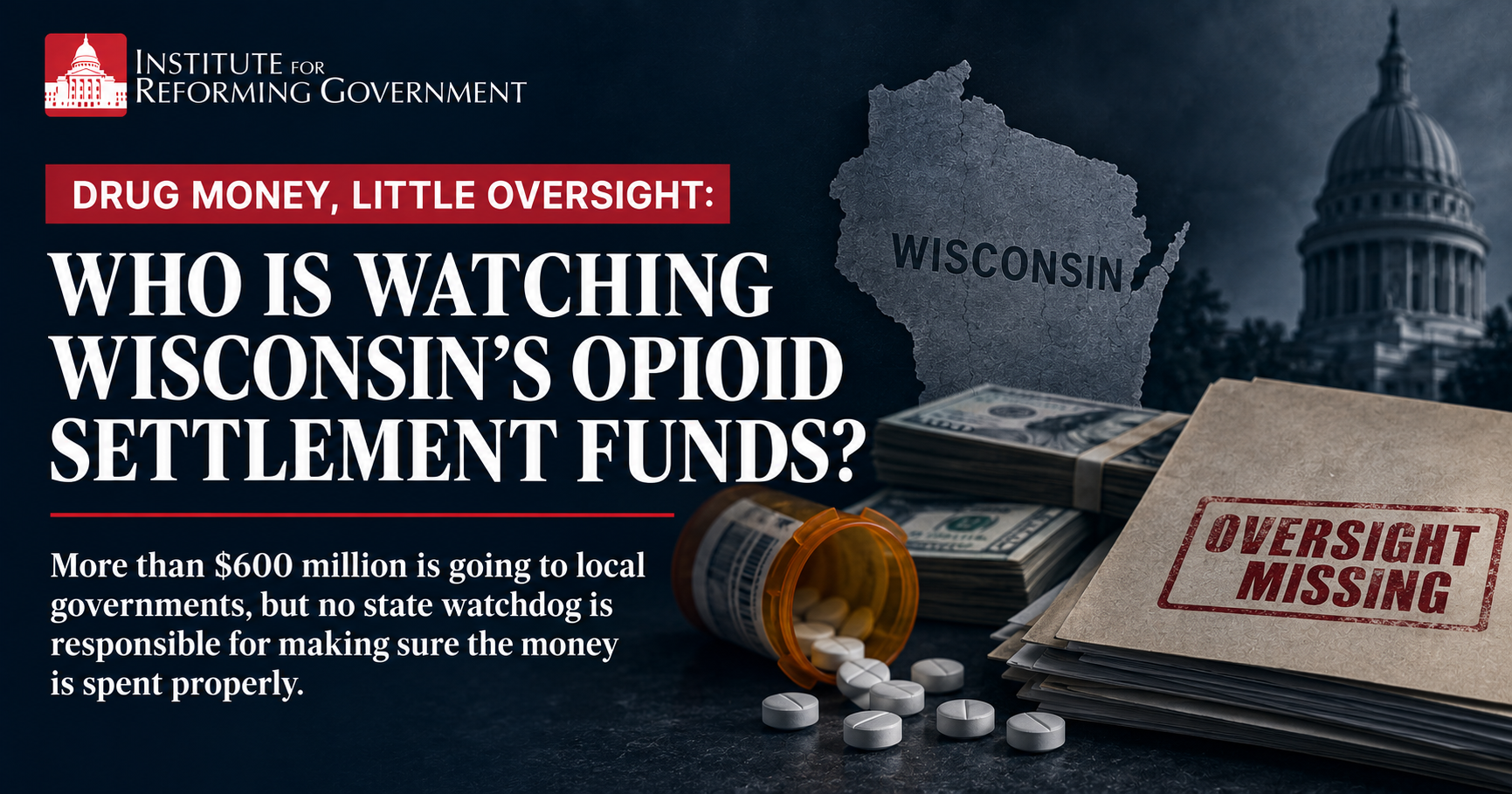
Drug Money, Little Oversight: Who Is Watching Wisconsin’s Opioid Settlement Funds?
More than $600 million is going to local governments, but no state watchdog is responsible for making sure the money is spent properly
DELAFIELD, Wis. — More than $600 million in opioid settlement funds is flowing to Wisconsin counties and municipalities, but no state agency is responsible for making sure the money is spent appropriately.
As found in the Institute for Reforming Government’s latest investigative report, Drug Money: How Wisconsin’s Counties Are (Mis)Spending Millions in Opioid Settlement Funds Without Oversight or Accountability, the result is vague public reporting, questionable expenditures, millions of dollars sitting unused, and little ability for taxpayers or lawmakers to determine whether settlement money is actually being used to combat the opioid crisis.
Wisconsin is set to receive more than $874 million from opioid lawsuits through 2038, with 70% going to counties and municipalities. Yet local governments are largely left to police their own compliance, even as settlement dollars have been used for everything from clean needles and smoking kits to license-plate surveillance cameras, rent, and student-loan forgiveness.
WHY IT MATTERS: Opioids killed 1,415 Wisconsinites in 2023 — nearly four people every day. The crisis is no longer confined to Wisconsin’s largest cities: 68 of the state’s 72 counties reported opioid-related deaths in 2023. With settlement payments continuing through 2038, Wisconsin still has time to put meaningful safeguards in place before hundreds of millions more are spent.
THE BIG PICTURE: Counties are required to file an annual report accounting for their opioid settlement receipts and spending, but state law does not specify how detailed that accounting must be. No state entity is charged with directly monitoring and auditing county spending. In practice, counties are largely left to oversee themselves.
THE FINDINGS:
- No real watchdog: The Legislature’s Joint Finance Committee, Department of Justice, and Department of Health Services all have roles in opioid settlement funding, but none is responsible for directly monitoring and auditing county spending. Counties are largely left to oversee their own compliance.
- Vague reports: Manitowoc County reported spending exactly $500,000 on “Prevention Programs” without a breakdown of the costs. The City of Milwaukee reported more than $1.6 million in spending across just four broad categories.
- Settlement funds skip prevention: Milwaukee County created twenty new positions, spent $19,000 on five autopsy carts, $192,000 on portable body cooler, and allocated $2.2 million for the Medical Examiner’s Office including student loan forgiveness for a forensic pathologist.
- Questionable spending: Settlement dollars have funded “harm reduction” programs that include clean needles and smoking kits, controversial Flock cameras in Oconto and Clark counties, rent subsidies in Marquette County and the City of West Allis, gas cards and smoke alarms in Waushara county, and potentially discriminatory spending focused solely on minority communities in Dane and Milwaukee counties, along with other expenditures with questionable connections to opioid abatement.
- Millions sitting idle: Numerous counties reported spending none of their settlement funds despite holding substantial balances. La Crosse County reported no expenditures from $2.9 million, Marathon County none from $2.2 million, and Dodge County none from $2.1 million.
- Reports may be missing altogether: Several local governments may have failed to submit the annual reports required by state law, further highlighting the weakness of the current reporting system.
WHAT THEY’RE SAYING:
“The money paid out to counties from the Opioid Settlement Fund is supposed to address the opioid crisis, and right now almost no one is watching how it gets spent,” said Maryjane Behm, IRG Deputy Director, Policy & Reform. “County reports are often vague, questionable spending can look more like a local wish list than opioid abatement, and there is no state watchdog responsible for making sure taxpayers can see where the money went. With hundreds of millions of dollars still to come, Wisconsin needs real oversight now.”
THE SOLUTION: Wisconsin is only about a quarter of the way through settlement payments scheduled from 2022 through 2038. IRG is calling on state lawmakers to strengthen oversight before hundreds of millions more dollars are distributed.
IRG recommends creating a dedicated body with authority to oversee county spending; establishing a searchable digital reporting portal so the public can easily see where settlement dollars go; strengthening reporting requirements so counties provide detailed expenditures and grant information; clarifying appropriate uses of settlement funds; and holding legislative oversight hearings to examine how money has already been spent to ensure it is accomplishing the intended goal.
GO DEEPER: Read IRG’s full investigative report, Drug Money: How Wisconsin’s Counties Are (Mis)Spending Millions in Opioid Settlement Funds Without Oversight or Accountability.
About the Institute for Reforming Government
The Institute for Reforming Government is a nonpartisan organization dedicated to putting the public record in front of the public. Its work is clear, sourced, and usable by anyone in five minutes. Learn more at reforminggovernment.org.