
FOR IMMEDIATE RELEASE
April 24, 2026
Contact: press@reforminggovernment.org
IRG Poll: Wisconsin Voters Want Cheaper Food, Lower Taxes and Smaller Government
A new poll finds continued sweeping, cross-party demand for affordability
Delafield, Wis. — Seven in ten Wisconsin voters say the state is in a cost-of-living crisis, three-quarters say their income has fallen behind inflation, and 42% name inflation and cost of living as the single most important issue heading into November’s governor’s race. Affordability dwarfs every other concern, according to an April 10–14 survey of 800 registered voters by RMG Research for the Institute for Reforming Government and Napolitan News Service, but the poll’s deeper numbers show a candidate of either party could win by owning a credible affordability agenda.
WHAT VOTERS WANT:
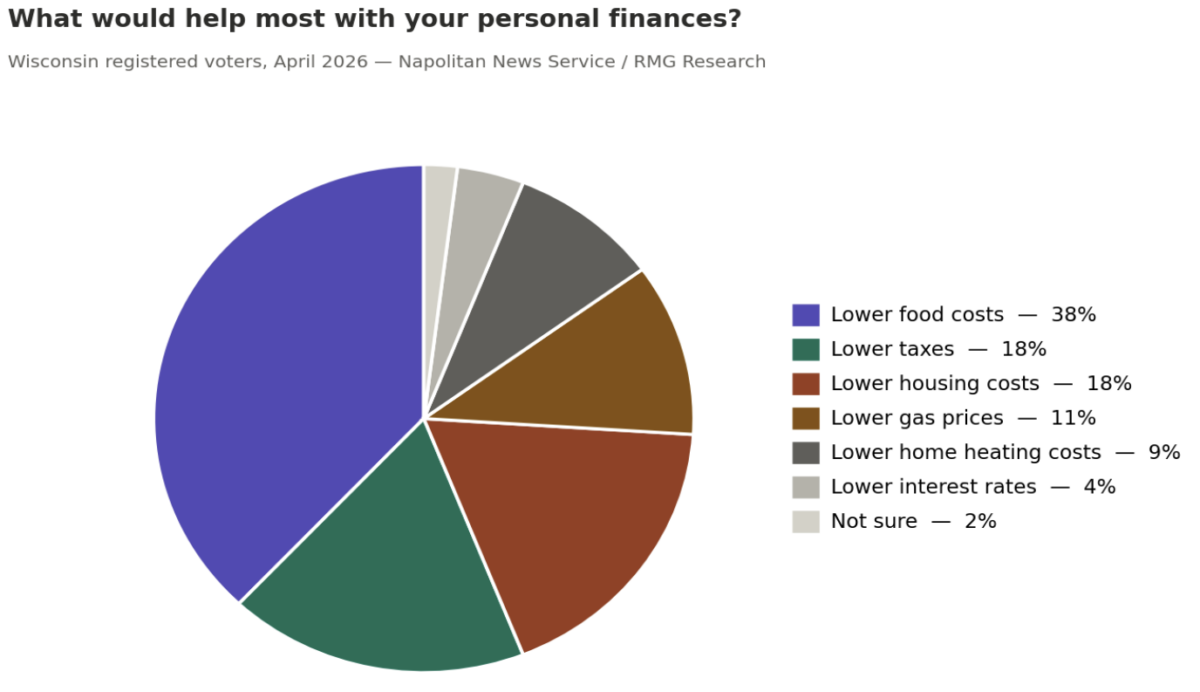
Voters are clear about what they want. When asked what would most help their personal finances, 38% said lower food costs, 18% said lower taxes and 18% said lower housing costs.
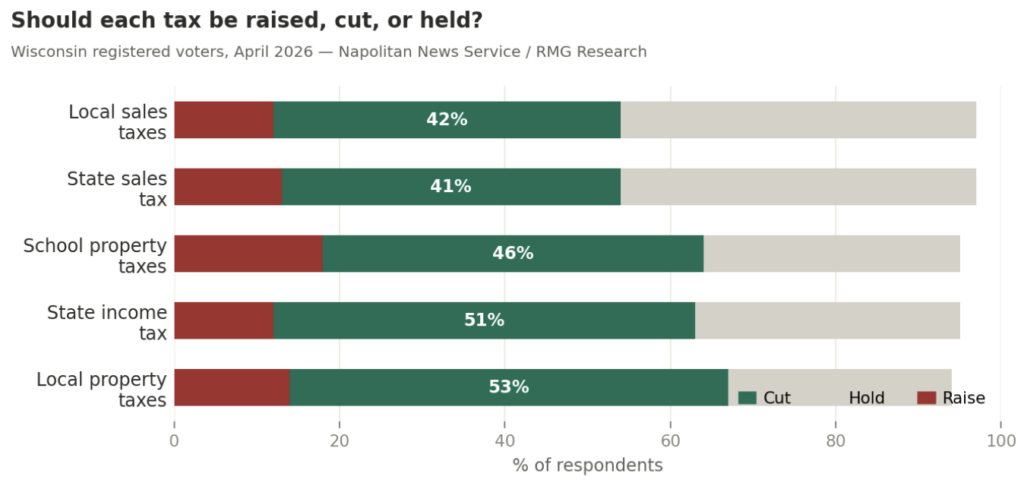
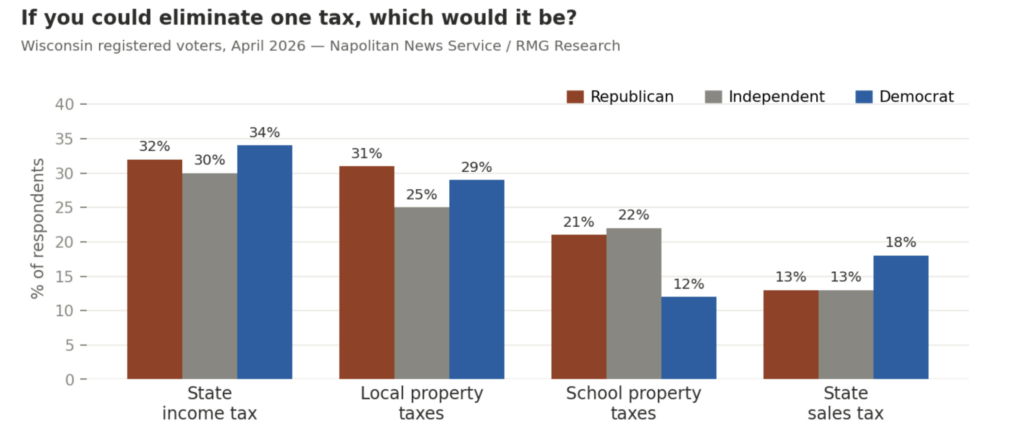
On taxes, the desire to cut runs across party lines. Majorities of Republicans, independents and Democrats want every major tax category reduced — state income taxes (51%), local property taxes (53%), school property taxes (46%) and sales taxes (41%). When asked to pick one tax to eliminate outright, 34% chose the state income tax — the top answer in all three parties.
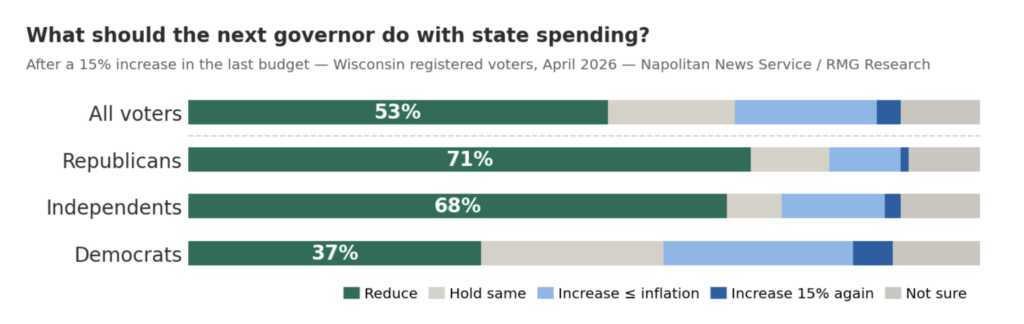
Spending restraint is the poll’s broadest cross-party consensus: 53% want the next governor to cut overall state spending after a 15% increase in the last budget. That includes 71% of Republicans, 68% of independents and 37% of Democrats. Only 3% want to repeat the last budget’s 15% increase.
THE QUOTE:
“Voters need to see a real plan from candidates in Wisconsin for helping with their personal finances. That’s the biggest item by far,” said CJ Szafir, CEO of the Institute for Reforming Government. “We also know from our Trump voter focus groups that the midterm voters will need to see how state policies impact their lives in real, credible ways. They are hungry for state solutions that will help their families thrive.”
OTHER POLICY SOLUTIONS:
The poll tested four items that could define the affordability debate at the state level.
UTILITY RATE INCREASE: The most lopsided result: 82% of voters oppose a proposed 14% utility rate increase currently pending at the Public Service Commission— a strong rejection that crosses all party lines.
MINIMUM MARKUP: On Wisconsin’s 1930s-era minimum markup law — which requires gas stations to mark up gasoline by 9.18% and bars retailers from selling groceries and other items below cost — 62% favor repeal, including majorities of Republicans and Democrats. The law was designed to protect small businesses after the Great Depression; critics say it now simply keeps everyday prices higher than in neighboring states.
DATA CENTERS: 35% of voters said they would favor a data center in their community, with 57% opposed. Opposition softens when the facility includes a self-contained power supply — support rises to 44% and opposition falls to 50% — but independents remain the most resistant group regardless of the power arrangement, with 60% opposed even with a self-contained power supply.
ACT 10: Despite the polarization around Act 10 since its passage in 2011, a plurality of voters today favor candidates who continue to support Act 10 versus those who oppose the measure, 47-35. Party breakdown on Act 10: Republicans 63-23, Democrats 36-47, and Independents 38-31.
WHO VOTERS BLAME:
Voters are also pointed about who they hold responsible. When asked what is primarily driving Wisconsin’s inflation, 46% named presidential policies — far ahead of state government (20%), Congress (17%) and factors beyond politicians’ control (6%).
THE RACE TODAY:
Democrats currently lead the generic gubernatorial ballot 50–43 and have an enthusiasm advantage. 52% of Democrats are enthusiastic to vote in November, while 39% of Republicans share that enthusiasm at the moment. Only 30% of Independents, the group most likely to decide the race, are enthusiastic to vote in November.
The numbers create a clear challenge and a clear opening for both parties.
For Democrats, the political environment is favorable, but voters want a concrete plan to reduce their costs, not just a contrast with federal policy.
For Republicans, the policy terrain is favorable — the demand for tax relief and spending restraint is broad and bipartisan. A Wisconsin-first affordability agenda is where the votes are.
November will be decided by a simple question: who has a real plan to make Wisconsin more affordable?
Survey conducted April 10–14, 2026, by RMG Research, Inc. for the Napolitan News Service. N=800 registered Wisconsin voters. Margin of sampling error: ±3.5 percentage points.
###
The Institute for Reforming Government is a non-profit 501(c)3 organization that seeks to simplify government at every level by offering policy solutions to thought leaders in American government in the areas of tax reform, government inefficiency, and burdensome regulations.